|
|
|
|
|
|


|
|
|
|
|
| |
Ten historic stations to explore...
| |
| |
|
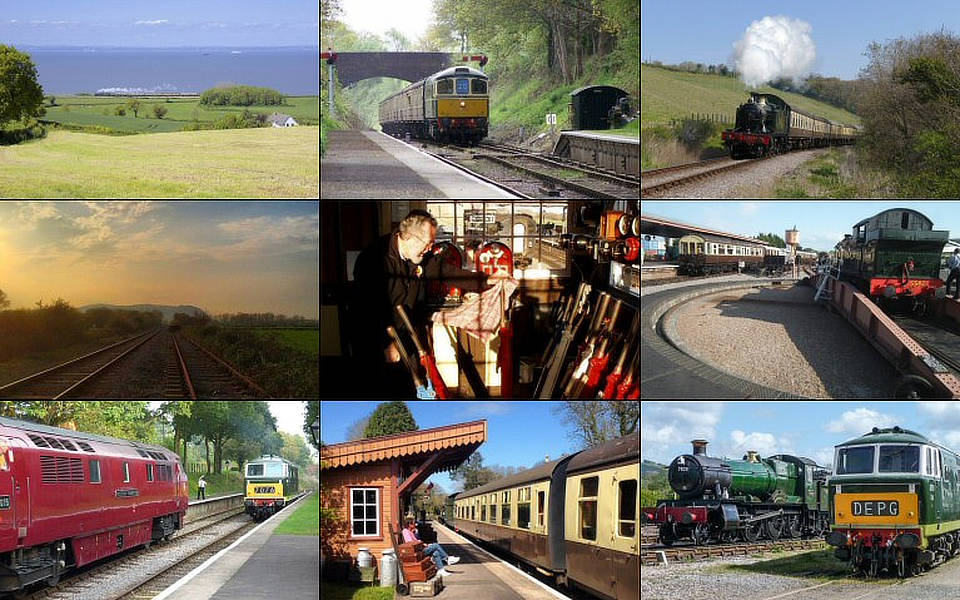
The Railway runs for over twenty miles, from Norton Fitzwarren, in the lush Vale of Taunton Deane, to Minehead on the Exmoor coast. The route passes between the Brendon Hills and the Quantock Hills until the sea is reached at Doniford. Then the line follows the coastline to Minehead, except for a brief excursion inland avoiding Cleeve Hill. The entire journey is spectacularly scenic. Click on the station names on the right for details about each Station...
Many of the station buildings on the Railway date from the opening of the line. The Railway was built in two parts: the original West Somerset Railway from Norton Fitzwarren to Watchet opened in 1862; and the Minehead Railway from Watchet to Minehead in 1874.
The Railway has ten stations, ranging from the small halts at Stogumber and Doniford to the terminus at Minehead where the platforms can each hold a sixteen coach train.
In the old days, trains ran to and from the county town of Taunton, connecting with the trains to all parts of the country.
The surrounding countryside includes the Quantock Hills (an Area of Outstanding Natural Beauty); the Exmoor National Park; the Bristol Channel and the Vale of Taunton Deane.
|
| |
The Abbreviated Station Names...
| |
| |
|
MD DR BA and so on - why did the Railway start using these abbreviations for the WSR stations. The story goes like this. When the "Stored Journey Ticket" was introduced for the diesel railcar service in 1977 - an effort to encourage local folks to use the train on a regular basis - the ticket had to carry the names of the stations between Minehead and Williton allowing ticketing staff to mark the two stations nominated by the passenger. Journeys could be made in the same direction if work demands required. Lack of space on the standard card ticket led to the creation of abbreviations MD for Minehead, DR for Dunster, BA for Blue Anchor, WD for Washford, WT for Watchet and WN for Williton. By the time the line was extended to Bishops Lydeard, the "Stored Journey Ticket" had been withdrawn, replaced by a scheme for local residents, the "Rail Users Association" which provided discounted fares on the already reduced fares then available for journeys exclusively made using the diesel railcars. More recently, the "Starcard" offers a similar discount for locals.
A further need for abbreviations in 1977 came with the introduction of card tickets printed with the fare value which required a date stamp and a mark showing the issuing station. The solution was to replace the usual two-digit year numbers with the station abbreviation.
The abbreviations are based on the first and last letters of single word names, and the leading letters of each word for two word names. Here is the full list...
|
| | MD | | MineheaD
| | DR | | DunsteR
| | BA | | Blue Anchor
| | WD | | WashforD
| | WT | | WatcheT
| | DD | | DoniforD
| | WN | | WillitoN
| | SR | | StogumbeR
| | CE | | CrowcombE (until name change)
| | CH | | Crowcombe Heathfield (since name change)
| | BL | | Bishops Lydeard
| | NF | | Norton Fitzwarren
|
Many thanks to Nick Jones and Chris van den Arend for these details...
|
|
|
|
| |
Test 1. See the WSR Stations with Google Earth. Click
here
| |
Test 2. See the WSR Stations with Google Earth. Click
here
|
|
|